908.627.3663 | download my resume





Tartan Food Tracker (v.2)
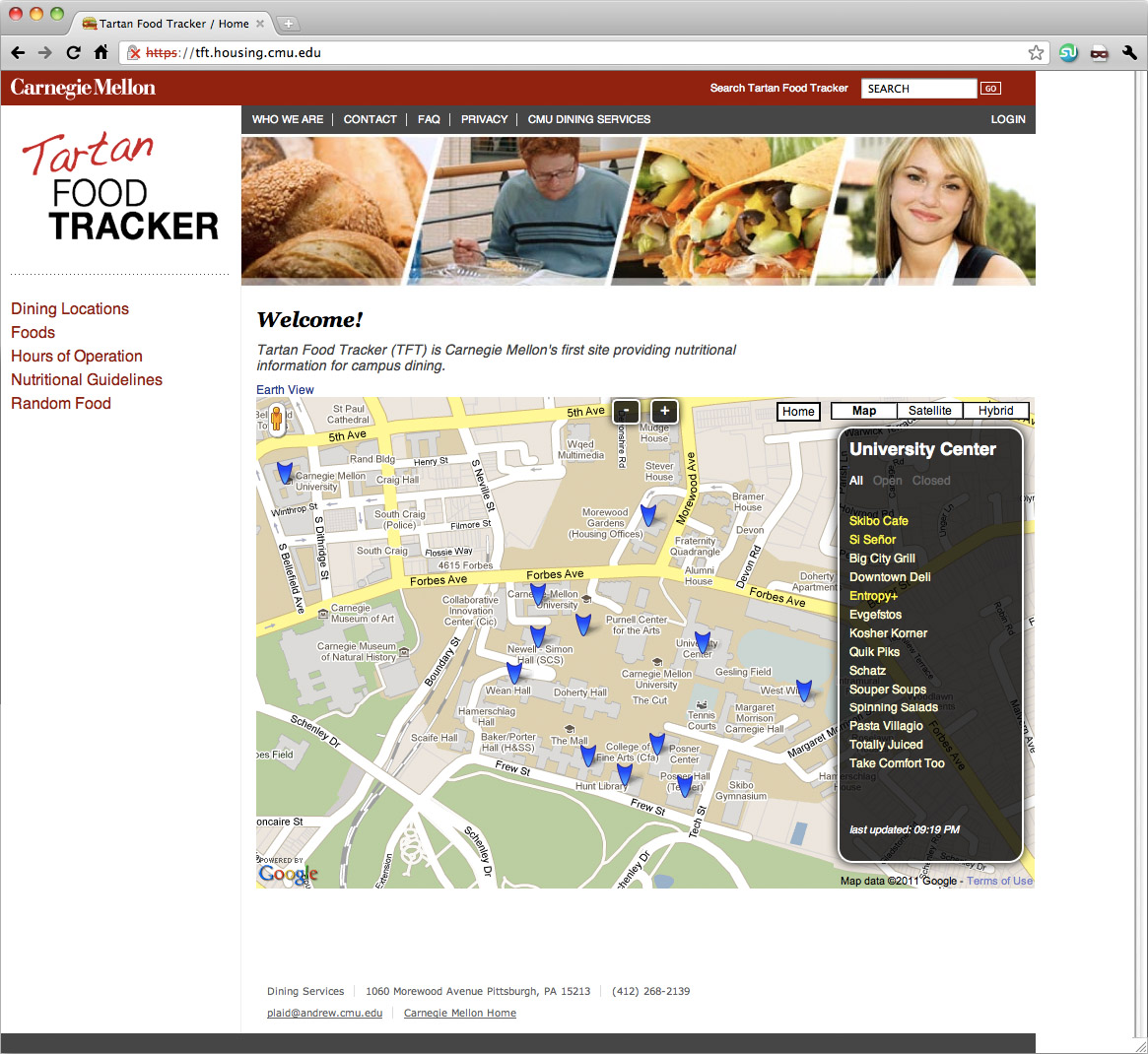
Tartan Food Tracker is a web application made specifically for Carnegie Mellon's campus. It allows students access to the nutritional information of on-campus dining so that students may become more aware of what they are putting in their bodies. Additionally, through TFT, users can keep a log of what they have been eating and gauge the popularity of different foods and restaurants across campus.
In the fall semester of 2010, our team recreated the application considering sustainability and scalability. Some of the things we worked on that semester included upgrading the application to rails 3.0, switching to a MySQL driven database as opposed to SQLite. Additionally, upon working with CMU, the design and style was integrated with the university and the application adopted the school's login system. Many other improvements were also made and the project continues to grow. A soft release is expected in the start of Spring 2011.
<< prev
next >>
View:
Date:
Client:
Word Search
This was the final game I created for my Experimental Game Design course. The game is a two-player game that races two players to uncover their phrase before the other. The arrow keys serve as the controls for player one and ASDW serve as the controls for player two. The physics of the game are a little whacky, but for the most part work in an expected manner. Incorrect guesses are penalized by freezing the player's screen.
<< prev
next >>
View:
Date:
Client:
Autumn Fall
This is one of the games I created for my Experimental Game Design course. The game gets tremendously harder as you continue to play but is overall a very simple and mindless game. I developed this game with classmate, Richard Chen. As a whole, we received a lot of positive feedback from the class - many compliments pertained to the game's 'cuteness'. In the future, I'd like to develop a few small changes such as other environmental details (tree branches, wild life) and disparity in the leaves as the player gets higher and higher.
<< prev
next >>
View:
Date:
Client:
HexaCrawler
This is my final project for my Making Things interactive class. The "HexaCrawler" is a six legged robot, known as a hexabot. This design was largely based off of Micromagic System's Design with a few modifications (mostly for the worse, seeing how this is my first attempt at making anything like this).
It was a very fun project, the parts are all laser cut from acrylic plastic, the microcontroller I used is an Arduino Diecimila. The hexabot works by using 12 servo gears (2 per leg) to move about and it is controlled via a Wii Nunchuck. I chose to do this as my final project because I thought it would be a fun way to take everything I learned from this class and make a fun, memorable toy / keepsake out of it.
<< prev
next >>
View:
Date:
Client:
High-Five Machine
This is just another robot I made as a small exercise for my Making Things Interactive course. The assignment was to create a machine with three states. I decided to make a machine that gives out high-fives. The three states were: rest, standby and high-fiving. There are two IR sensors in the system, one that detects if you are nearby (brings the machine to standby position), and one to see if your hand is in position (high-fiving state). When no one is near either sensor, the system is in rest state.
I hope you all enjoy the rather comical video... please ignore the fact that you can see my thighs.
<< prev
next >>
View:
Date:
Client:
Tartan Food Tracker
Tartan Food Tracker is a web application made specifically for Carnegie Mellon's campus. It allows students access to the nutritional information of on-campus dining so that students may become more aware of what they are putting in their bodies. Additionally, through TFT, users can keep a log of what they have been eating and gauge the popularity of different foods and restaurants across campus.
The application was initially made by me and four other students for a class project but since its start, it has become quite a bit more. This semester, we have been working hard with Housing and Dining and Student Health Services to obtain accurate nutritional facts and integrate the application into the CMU system.
<< prev
next >>
View:
Date:
Client:
Pong Breaker
Created for my "Experimental Game Design" course. The assignment was to 'mod' a given piece of source code for breakout in any manner you choose. I really enjoyed my tweaked version because it actually turned out to be a pretty enjoyable game. The game is a two player game and the objective is to get all of your blocks hit before the opposing player does so. Unfortunately, the professor beat me at my own game during my presentation.
This assignment was modeled off an exercise used by Game Mod. Check out what others did.
<< prev
next >>
View:
Date:
Client:
Hangman
During the spring semester of 2010, I took a class that focused heavily on Flash and actionscript. For my final project, me and a group of three created a series of games focused on helping and educating children. The initial idea was to translate the game to Spanish and target this for children of Hispanic heritage so that they may learn English easier.
The game itself is very customizable. Through an accompanied text file, you can give the application a different set of words to choose from and/or take out the 'hint' functionality. This is nice because it gets more difficult and adults can enjoy the game as well.
<< prev
next >>
View:
Date:
Client:
Marshmallow
This is one of the first introductory assignments we had in using sensors and motors with the Arduino microcontroller. The assignment was to simply make something move or change shape based on human interaction. For the assignment, I made a dog out of paper that would wag his tail faster the closer you got to it. If no one is around, he wags his tail very slowly.
The mechanics of it is very, very simple. There is just one servo attached to the dog's tail inside the oragami figure and an IR sensor peeking out of the dog's front. Reading from the IR sensor, I can adjust the servo's speed.
<< prev
next >>
View:
Date:
Client:
LOADING...