Tartan Food Tracker (v.2)
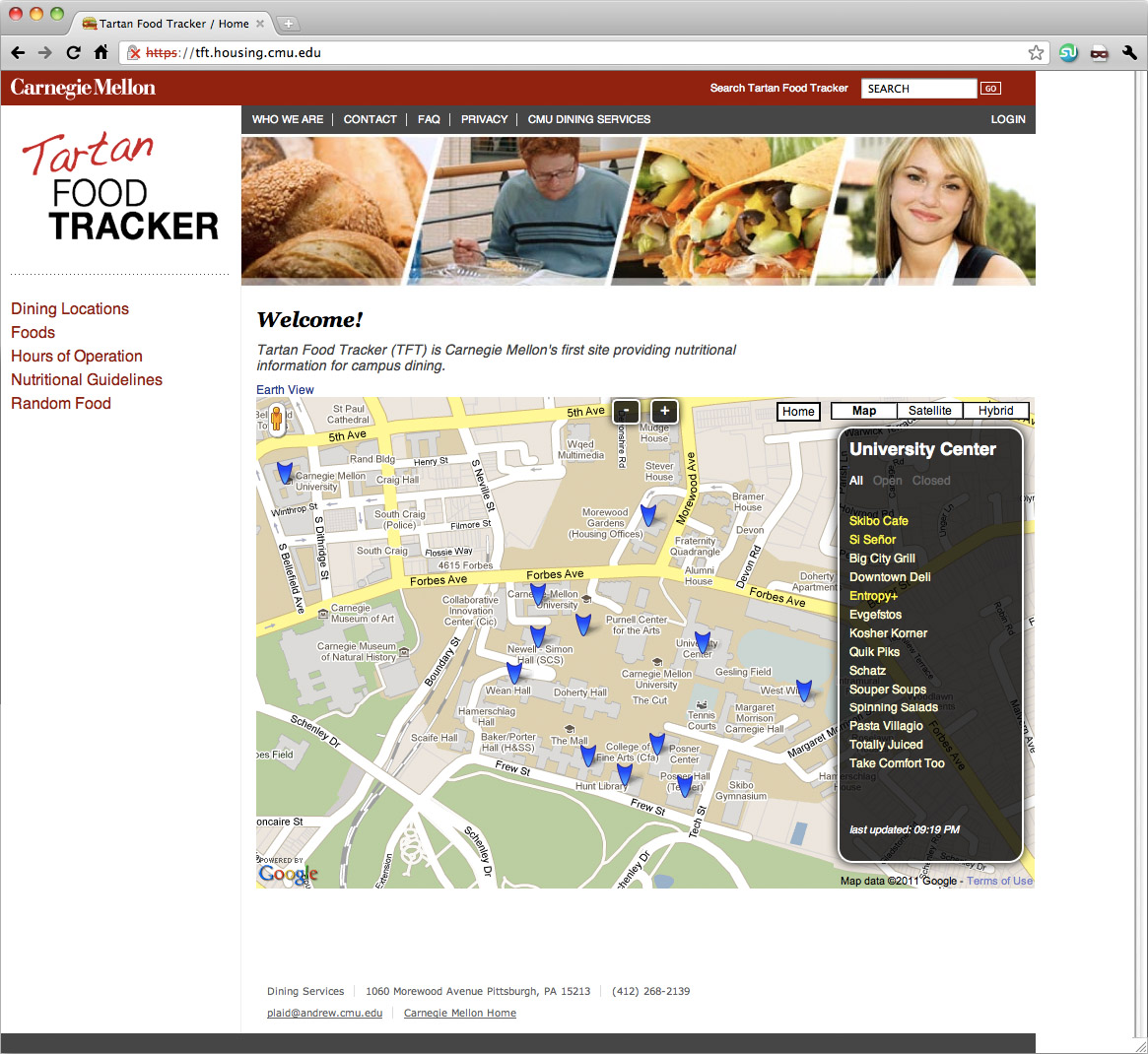
Tartan Food Tracker is a web application made specifically for Carnegie Mellon's campus. It allows students access to the nutritional information of on-campus dining so that students may become more aware of what they are putting in their bodies. Additionally, through TFT, users can keep a log of what they have been eating and gauge the popularity of different foods and restaurants across campus.
In the fall semester of 2010, our team recreated the application considering sustainability and scalability. Some of the things we worked on that semester included upgrading the application to rails 3.0, switching to a MySQL driven database as opposed to SQLite. Additionally, upon working with CMU, the design and style was integrated with the university and the application adopted the school's login system. Many other improvements were also made and the project continues to grow. A soft release is expected in the start of Spring 2011.
websiteJan. 2010 - Present
CMU Housing & Dining
Tartan Food Tracker (v.1)
Tartan Food Tracker is a web application made specifically for Carnegie Mellon's campus. It allows students access to the nutritional information of on-campus dining so that students may become more aware of what they are putting in their bodies. Additionally, through TFT, users can keep a log of what they have been eating and gauge the popularity of different foods and restaurants across campus.
The application was initially made by me and four other students for a class project but since its start, it has become quite a bit more. The version you see here was created in the spring semester of 2010. Since then, the application has grown in design, scalability and efficiency.
KinderTab
This project was a proposal for a fictional design of an education tool placed years in the future - where ubiquitous computing has been thoroughly integrated into everyday items. The exact assignment was to design a ubiquitous system that would assist someone a social context. The project was annoying at the time but in hindsight, very useful.
After deciding on improving the student/teacher relationship, we went through several iterations playing around with exact demographics and what our overall purpose should be (improve teaching? parents? scheduling?). The most difficult part of the assignment was understanding that although a technological solution is available, it is not always a good fit for the problem - especially a social problem. It took several iterations and many rounds of user testing to really nail the idea.
BookFace
This was a group project for my HCI Methods course. The project lasted through the entire semester and concentrated on utilizing different HCI research methods to make a book collection management system. Our group was given a Contextual Inquiry from a local book collector (representing prospective clients), a Think-Aloud on the CollectionStudio software and survey results regarding the usability and helpfulness of similar existing applications such as Booktagger and LibraryThing.
Using design models such as cultural, flow and sequence models we found what drove our clients and what were the best ways of helping them achieve their goals. For example, we discovered a function the clients held dear was the ability to link books with other books (arbitrarily or categorically). Using Keystroke-Level Modeling, Think Alouds and UARs we optimized our interface.
N/A
Fall 2009
HCI Methods (class)
Copier Redesign
Our assignment was the identify a human factors problem and to find a solution. For a while now, I've noticed that there is a problem with the usability of copiers. Many people get confused with any task more complicated than making one copy of a single-sided paper. The interfaces on copier machines are generally excessively complicated and very hard to understand.
By creating a task analysis testing three simple tasks on a copier, I conducted multiple user tests on the copiers located at CMU's Hunt Library. I discovered that first-time users rarely succeed on accomplishing their desired goal. There were many issues with the copier, such as inconsistency, information overload and recognition vs. recall. My redesign of the interface addressed all of these issues and more. For a more detailed report, please click the link below.
PaddlingStuff
In the summer of 2008, I independently built, designed and maintained this website with the help of Network Solution's eCommerce. Additionally, a lot of time was spent filling out the system's database and search engine optimization. It is important to note that Network Solutions helped tremendously with the back end of this project. It covered all security issues and database maintenance.
Note: I am no longer in charge of maintaining or updating this website.
How to Fly
This playful 'choose your own adventure' story served as my introductory assignment into Flash. The assignment was to create a story with (at least) one happy ending and (at least) one sad ending. Personally, I had a lot of fun making this project and making it as creative as possible.